
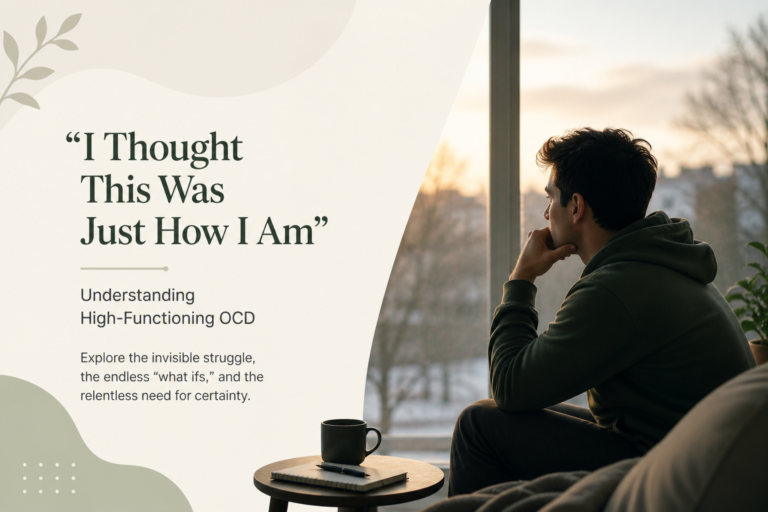
For many people, it doesn’t begin as a concern.
It feels like being careful. Responsible. Someone who thinks deeply, checks thoroughly, and wants to do the right thing.
Over time, though, these patterns can quietly grow –
more thinking, more doubt, more effort to feel certain.
And because life still “works,” it often gets normalised.

When It Looks Like Functioning
High-functioning OCD doesn’t always look obvious.
You may be managing work, relationships, and responsibilities well. Others may see you as detail-oriented, thoughtful, or even perfectionistic.
But internally, it might feel like:
- Constant rumination and overthinking
- Spending excessive time researching decisions or possibilities
- Indecision, even over small choices, until things feel completely certain
- A strong need for things to be perfect or “just right”
- A heightened sense of responsibility or morality – worrying about doing the wrong thing
- Subtle or repeated reassurance seeking (from people, the internet, or your own thoughts)
- Underlying anxiety and irritability from mental fatigue
Because these patterns have been present for so long, they can start to feel like part of your personality.
What’s Actually Happening?
At its core, OCD is not about being particular- it’s about getting caught in a loop.
A thought creates doubt → doubt creates anxiety → the mind tries to resolve it by analysing, checking, researching, or seeking reassurance → temporary relief → and then the doubt returns.
In high-functioning OCD, many of these responses are internal:
- Replaying situations repeatedly
- Searching for the “right” answer online
- Trying to feel 100% sure before deciding
- Asking others for reassurance, sometimes indirectly
These are not just habits – they are ways the mind tries to feel safe and certain.
The Part That Often Goes Unnoticed
Because these patterns don’t disrupt functioning on the surface, they are often explained away:
- “I’m just someone who overthinks.”
- “I like to be sure before I decide.”
- “I have high standards.”
- “I just care about doing the right thing.”
But over time, this comes at a cost:
- Mental exhaustion
- Difficulty being present
- Increased anxiety when certainty isn’t possible
- A life that slowly starts revolving around avoiding doubt
You may not realise how much you’ve been adjusting around these patterns.

A Gentle Shift in Understanding
Recognising this is not about labelling yourself – it’s about understanding your experience more clearly.
If your thoughts feel repetitive, hard to step away from, and driven by a need for certainty, perfection, or moral correctness, it may be more than just overthinking.
And importantly, it’s something that can be worked through.
What Can Help
- Noticing when you’re trying to feel “completely sure”
- Allowing small amounts of uncertainty, gently and gradually
- Reducing reassurance-seeking, even in subtle forms
- Taking decisions without over-researching every possibility
- Seeking professional support to understand and break the cycle safely
A Gentle Reminder
You’re not “like this” because something is wrong with you.
You may have been coping in ways that once helped you feel in control – but are now becoming exhausting.
At I’M Powered, we understand how overwhelming and invisible these patterns can feel. If you recognise yourself in these experiences, you don’t have to navigate them alone. With the right support, it is possible to step out of these cycles and find a more balanced, easeful way of living.
You don’t have to keep adjusting around it.
You can understand it – and slowly, begin to loosen its hold.
Book your consultation Now: WhatsApp Now